Episode 7 · WSPR and FT8 · Series 01: The Listening Station
How far does a whisper travel?
 Coming soon
- Release
- Length
- 3:02
- On the dial
- 14 MHz and more
- Signal
- FT8 and WSPR
What it covers
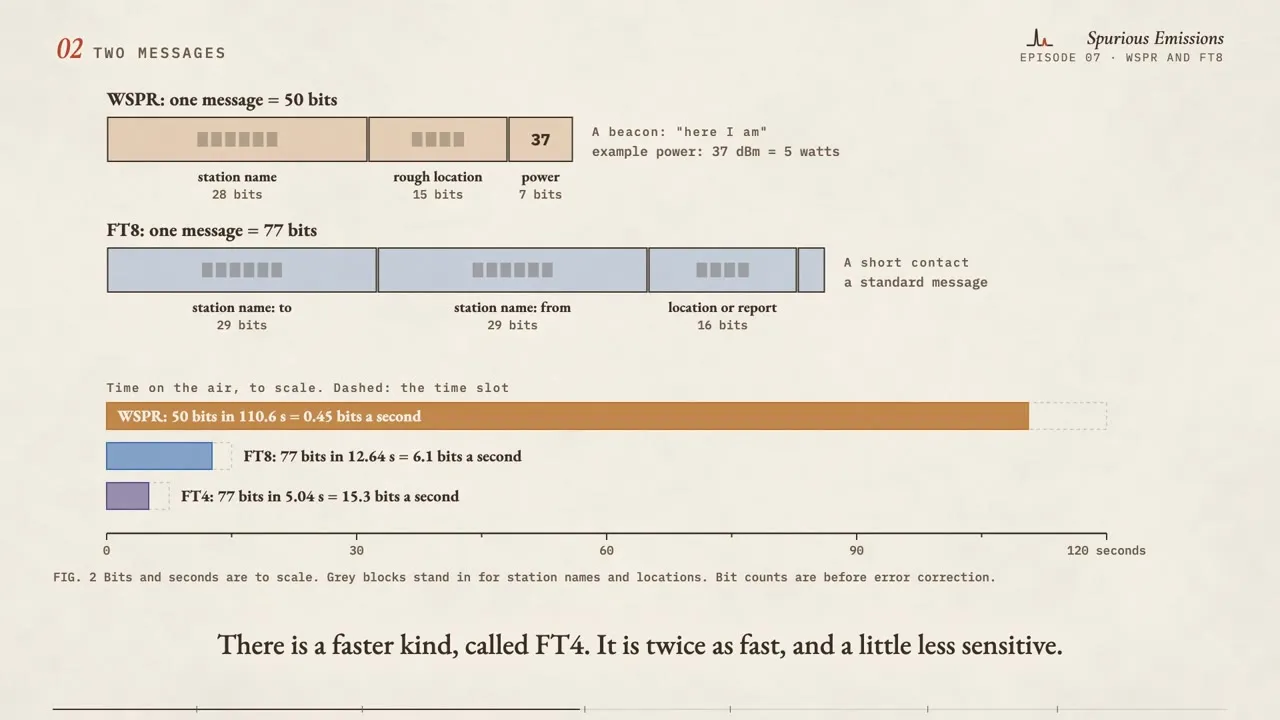
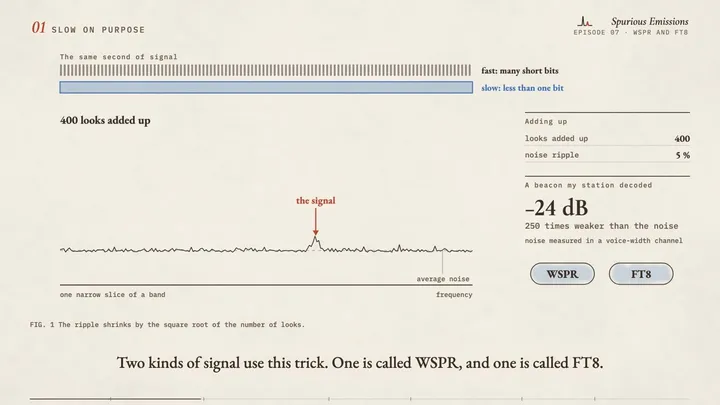
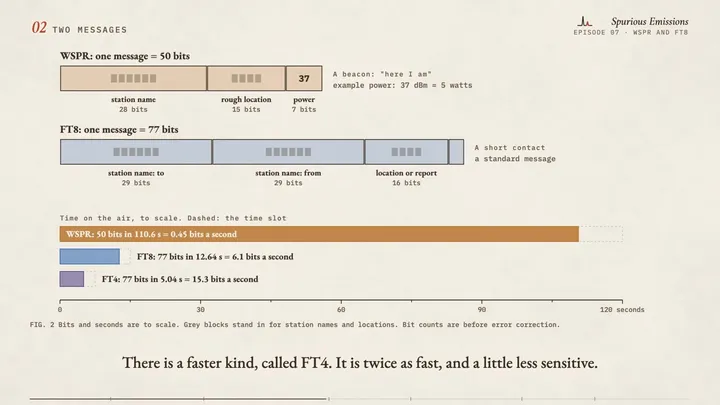
WSPR and FT8 are tiny, slow radio signals that amateurs all over the world send with a few watts or less. A computer can decode them far below the noise, because each message says almost nothing and says it very slowly. I explain what one WSPR message and one FT8 message hold, why every station starts on an exact clock, and how my station listens on every shortwave band at once and counts where the signals came from.
Chapters
- 0:00Intro
- 0:23Slow on purpose
- 0:49Two messages
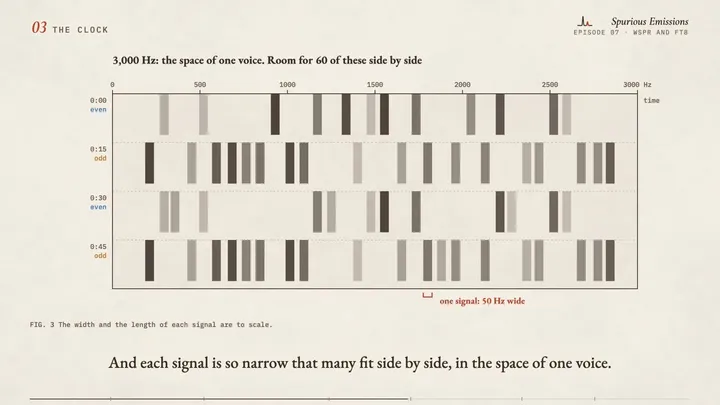
- 1:24The clock
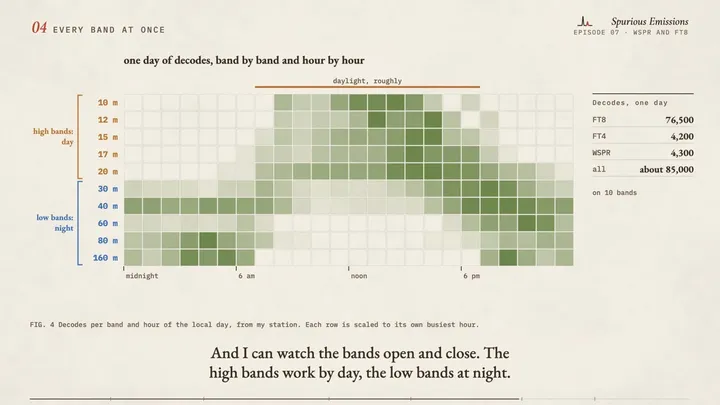
- 1:47Every band at once
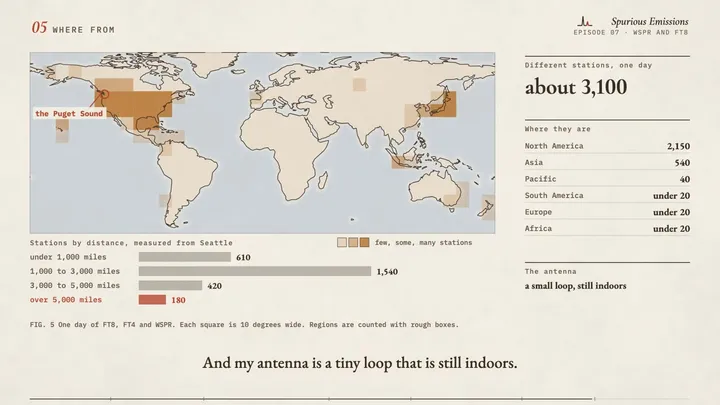
- 2:18Where from
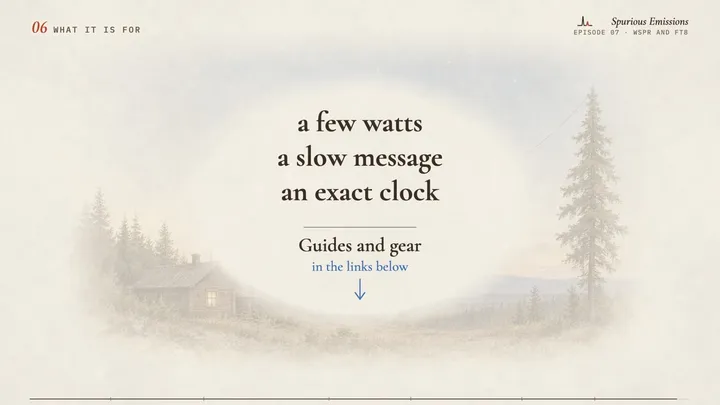
- 2:38What it is for
Frames from the draft
Gear in this episode
| RX-888 Mk II | the receiver that hears all of shortwave at once (mine is from OpenSourceSDRLab) |
| MLA-30+ loop antenna | the small active loop antenna for shortwave |
| TAPR RF Limiter | protects the receiver input from strong signals |
| HP EliteDesk small form factor PC | the shortwave computer I call Raphael (mine was rescued from e-waste) |
| CyberPower CP1500PFCLCD UPS (1500 VA, sine wave) | the battery backup that keeps almost all of my station running through a power cut |
Software and references
| WSJT-Xwsjt.sourceforge.io | the program that WSPR, FT8 and FT4 come from. It includes wsprd, the WSPR decoder I run |
| ft8_lib (ka9q fork)github.com | the source of decode_ft8, the FT8 and FT4 decoder I run |
| ka9q-radiogithub.com | the program that cuts one channel for each band out of the receiver's stream (episode 5) |
| The FT4 and FT8 Communication Protocolswsjt.sourceforge.io | the paper by the authors of the modes: bits, tones, timing and sensitivity |
What is simplified, and what is invented
- No callsign and no locator appears in this video. Grey blocks stand in for station names and locations in the example messages. The power level in the WSPR example is invented.
- The counts are one day from my station, rounded. Only totals are kept: by mode, band, hour, world region and distance band.
- World regions are counted with rough latitude and longitude boxes. Distance is measured from downtown Seattle, a public landmark.
- Map squares are 10 degrees wide and show three shades, not counts. The mark for my region shows the region only.
- The noise picture in scene 1 is an illustration with an invented signal. Real decoders do more than add up: they also use strong error correction.
- The message drawings show standard messages and leave out the error-correction bits. Bits and seconds are to scale.
- The waterfall in scene 3 is an illustration, not a recording. The width and the length of each signal are to scale.
- In the band and hour chart, each row is scaled to its own busiest hour. The daylight bar is rough.
- World coastline: Natural Earth (public domain).