Episode 9 · Distress Calls, Beacons, and HFGCS · Series 01: The Listening Station
What else is out there? Distress calls, beacons, military voices.
 Coming soon
- Release
- Length
- 4:26
- On the dial
- 2 to 28 MHz
- Signal
- Distress watch (DSC)
What it covers
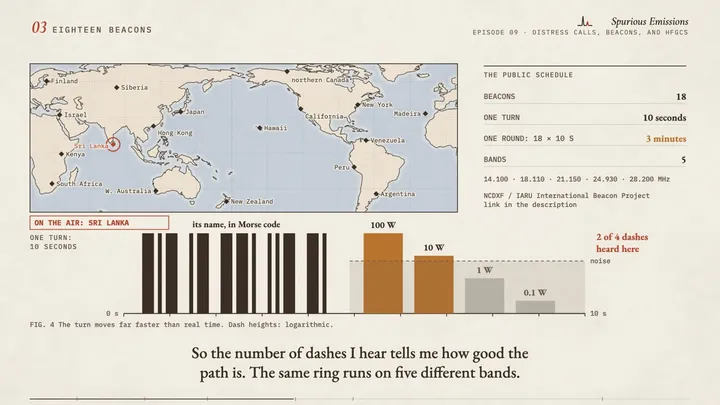
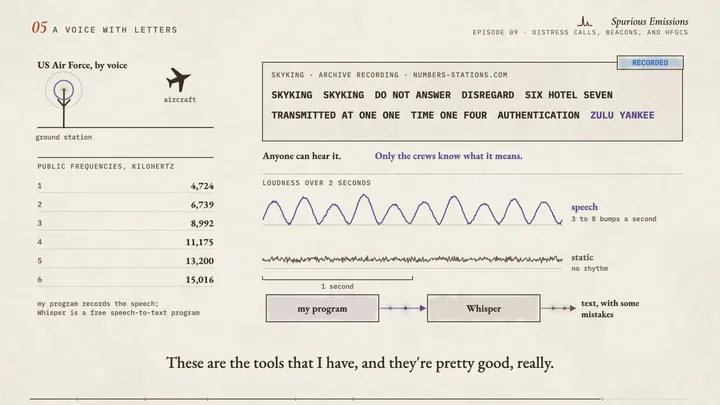
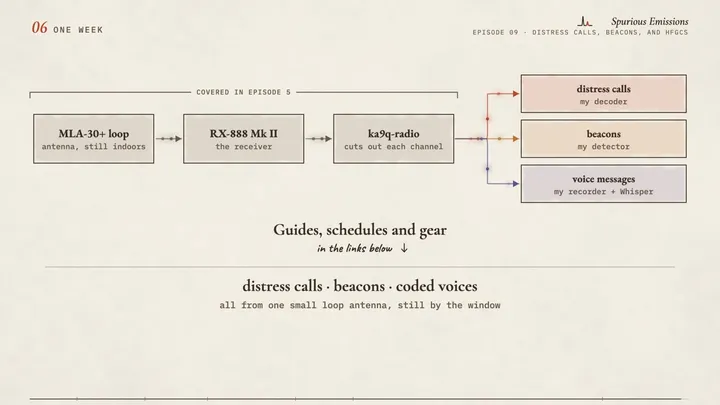
My shortwave receiver hears far more than weather maps. In this video: the digital distress and calling system that ships use (DSC), the eighteen beacons around the world that take turns on one frequency (the NCDXF/IARU International Beacon Project), and the voice messages of the United States Air Force (HFGCS). I explain how each one works and what my own station in the Puget Sound really hears on a small indoor antenna, including how little that sometimes is.
Chapters
- 0:00Intro
- 0:20A distress button
- 0:47Six frequencies
- 1:13Eighteen beacons
- 1:49What I hear
- 2:12A voice with letters
- 3:53One week
Frames from the draft
Gear in this episode
| RX-888 Mk II | the receiver that hears all of shortwave at once (mine is from OpenSourceSDRLab) |
| MLA-30+ loop antenna | the small active loop antenna for shortwave |
| HP EliteDesk small form factor PC | the shortwave computer I call Raphael (mine was rescued from e-waste) |
| CyberPower CP1500PFCLCD UPS (1500 VA, sine wave) | the battery backup that keeps almost all of my station running through a power cut |
Software and references
| ITU-R M.493itu.int | the public standard for digital selective calling (DSC): how a call is built and checked |
| Digital selective calling (US Coast Guard)navcen.uscg.gov | what DSC is, in plain words, and the distress and safety frequencies |
| NCDXF/IARU International Beacon Projectncdxf.org | the eighteen beacons, where they are, and the transmission schedule |
| High Frequency Global Communications Systemen.wikipedia.org | a public overview of the US Air Force network and its frequencies |
| ka9q-radiogithub.com | the program that cuts one channel for each signal out of the receiver's stream (open source, by Phil Karn; episode 5) |
| faster-whispergithub.com | the free speech-to-text program (a fast version of OpenAI's Whisper) that writes down the recorded speech |
What is simplified, and what is invented
- The three decoders (distress calls, beacons, voice recorder) are small programs I wrote for my station. They are not public.
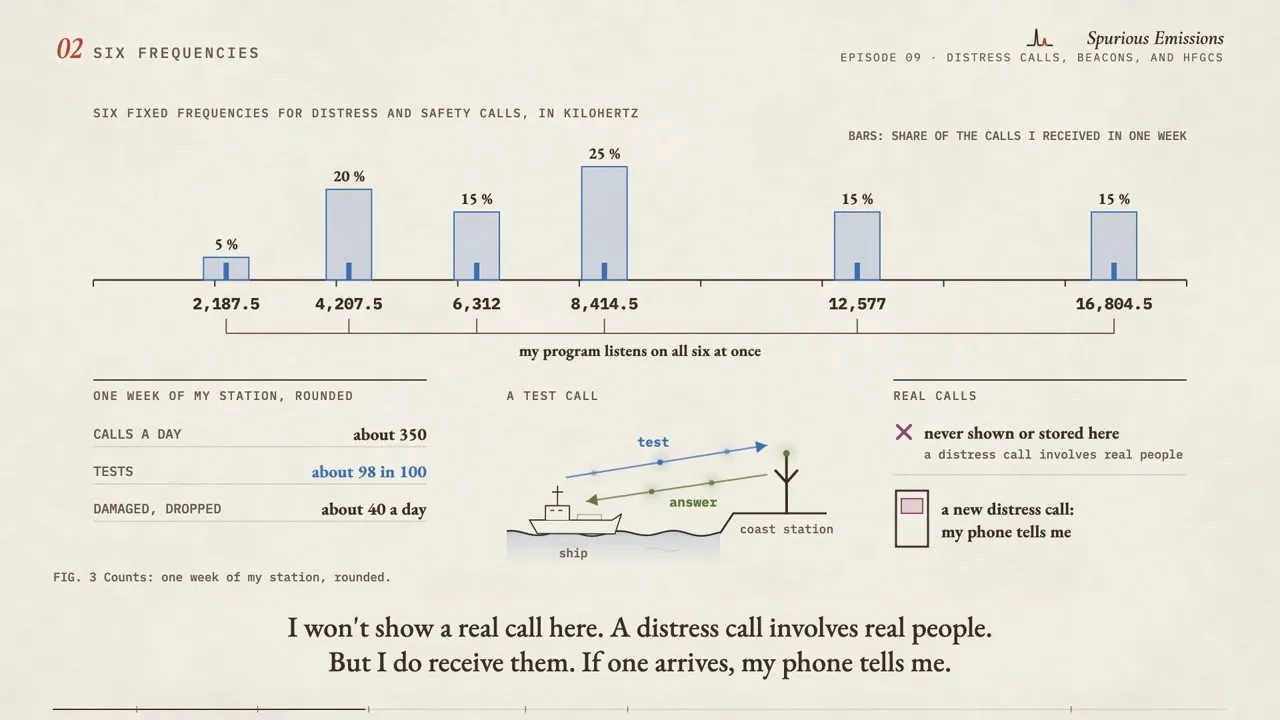
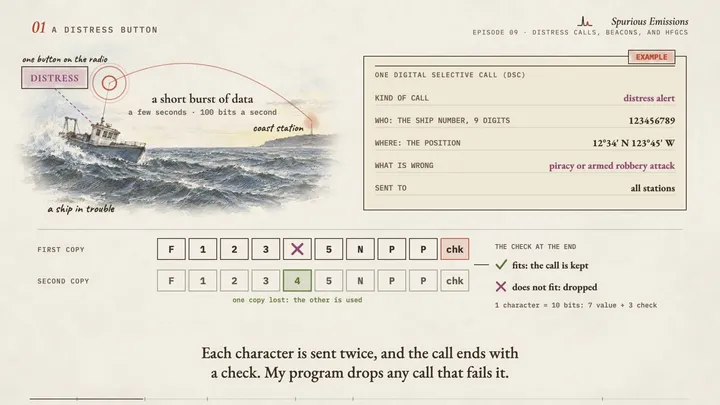
- The distress call on screen is an example that I wrote. The ship number and the position are invented. I never show or store a real call here: a distress call involves real people.
- The voice message on screen is invented. I do not show or publish recordings or their text.
- The speech and static traces are drawn for the video, not recorded.
- Beacons are named by their place. The beacon schedule and locations are from the NCDXF/IARU International Beacon Project. Marks on the map are at city or region level.
- On the beacon map the turn moves far faster than real time. The Morse marks spell no real name, the timing inside the ten seconds is simplified, and the dash heights use a logarithmic scale.
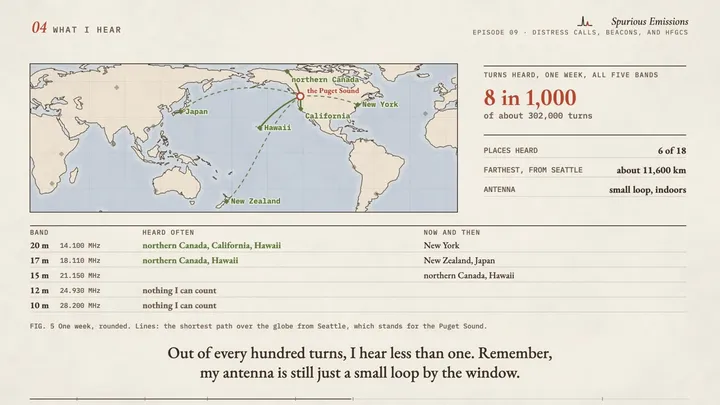
- Map coastline: Natural Earth (public domain). The lines are great circles from Seattle, which stands for the Puget Sound.
- The ship, coast station and aircraft drawings are illustrations, not to scale.
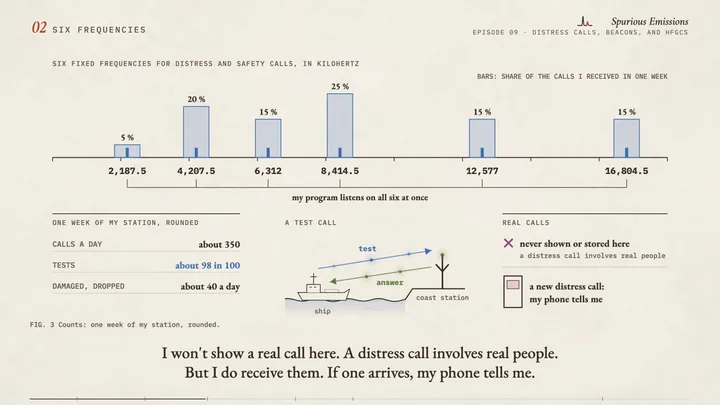
- All counts are one week of my station, rounded. My antenna is still a small loop indoors.