Episode 13 · Numbers Stations · Series 01: The Listening Station
Who broadcasts numbers on shortwave, and what reaches my station?
 Coming soon
- Release
- Coming soon
- Length
- 10:52
- On the dial
- Shortwave, by timetable
- Signal
- Numbers stations
What it covers
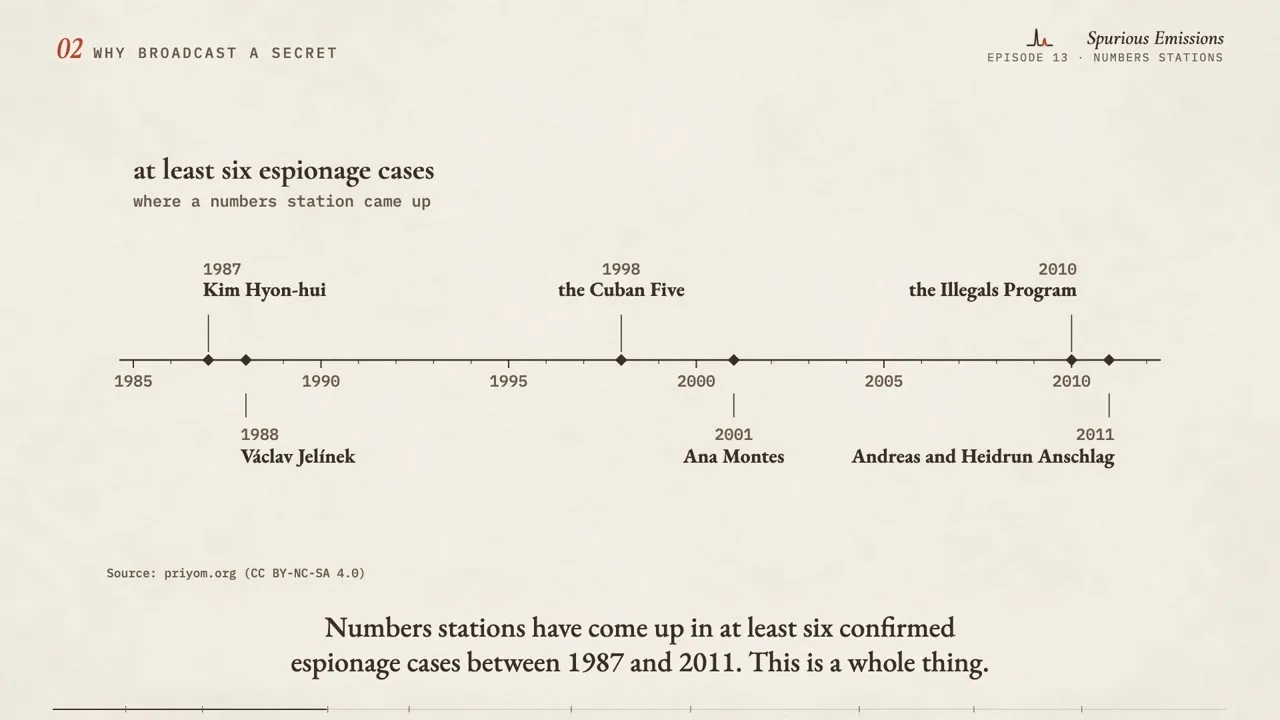
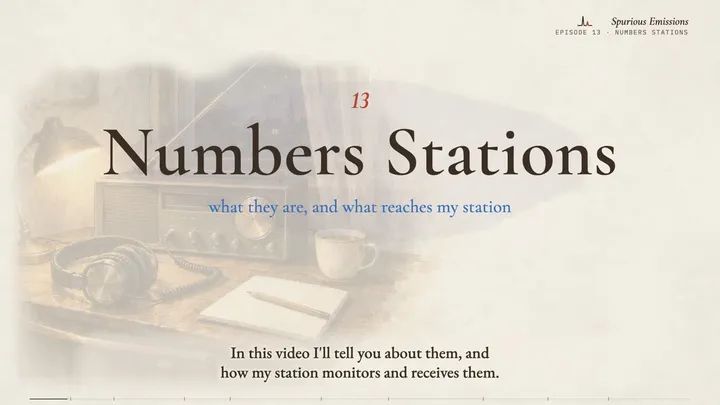
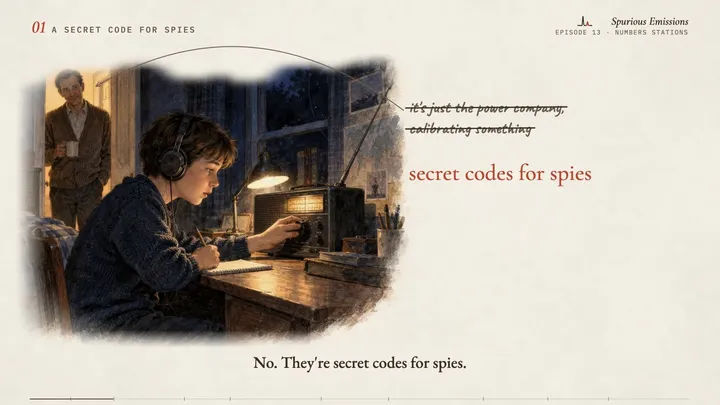
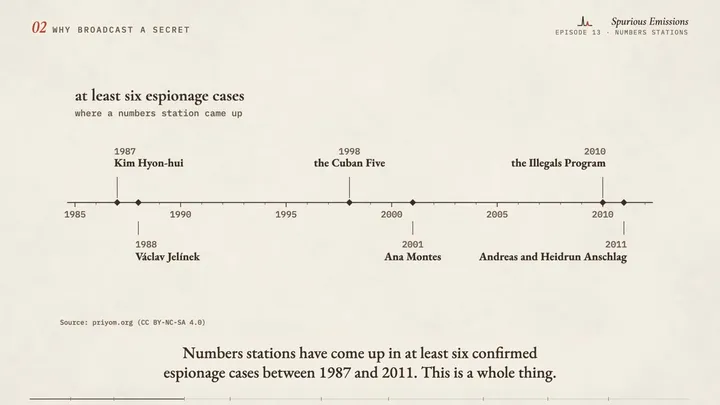
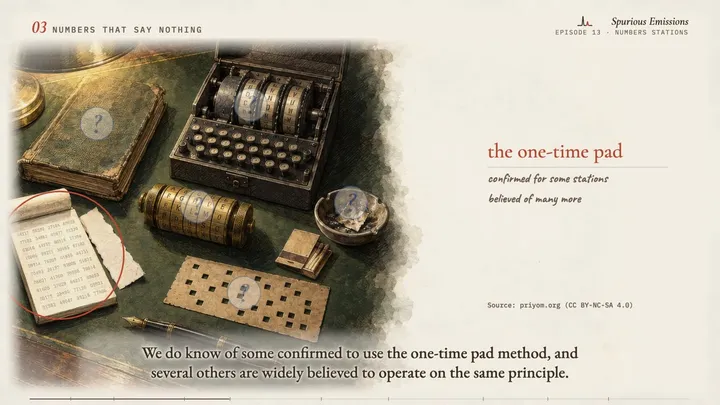
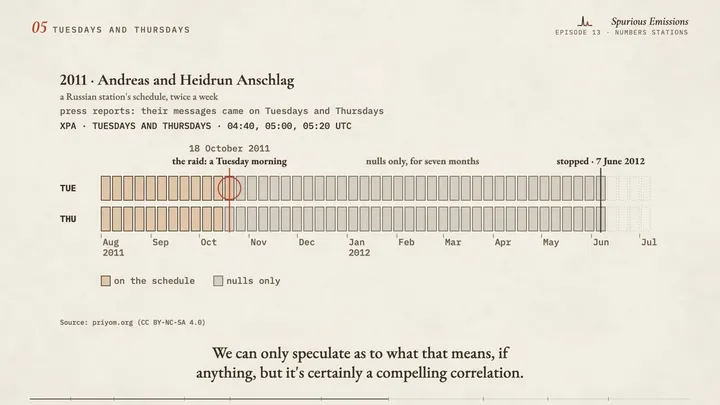
Numbers stations are shortwave broadcasts from intelligence agencies to their agents abroad: secret codes for spies, really. In this video: why an agency would broadcast a secret, how a one-time pad makes the numbers say nothing, what still leaks from a timetable, the 2011 arrest of a couple at their shortwave receiver, and how my own station in the Puget Sound records every transmission on the published schedule.
Chapters
- 0:00Intro
- 0:41A secret code for spies
- 1:24Why broadcast a secret
- 2:34Numbers that say nothing
- 3:19What still leaks
- 4:49Tuesdays and Thursdays
- 5:56Who is on the air
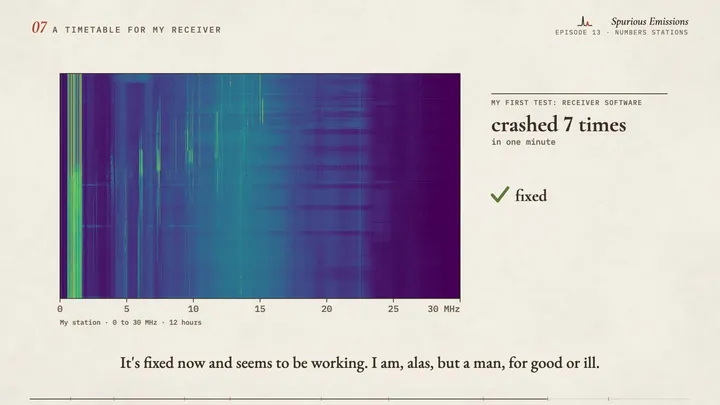
- 7:30A timetable for my receiver
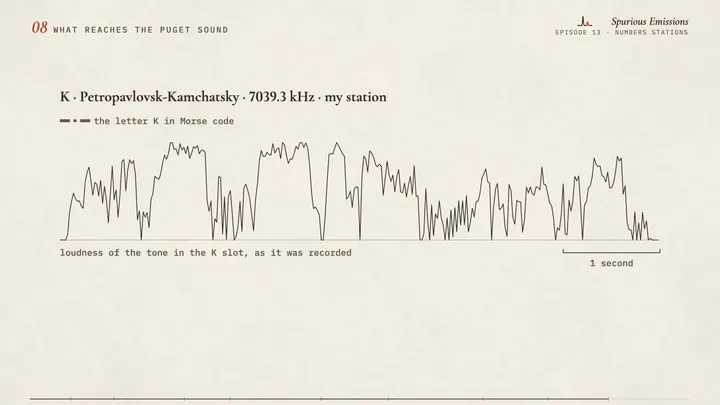
- 8:34What reaches the Puget Sound
- 9:34Intro
Frames from the draft
Gear in this episode
| XHDATA D-808 | a portable shortwave radio with SSB (and the air band) |
| Tecsun PL-368 | a pocket shortwave radio with SSB |
| Eton Elite 750 | a classic big portable with SSB and a rotating AM antenna |
| Tecsun PL-880 | a portable shortwave radio with SSB |
| DX-286 | a great portable receiver (TEF6686 chip), but no SSB, so it can't play single-sideband stations like V32 |
| RX-888 Mk II | the receiver that hears all of shortwave at once (mine is from OpenSourceSDRLab) |
| MLA-30+ loop antenna | the small active loop antenna for shortwave |
| HP EliteDesk small form factor PC | the shortwave computer I call Raphael (mine was rescued from e-waste) |
| CyberPower CP1500PFCLCD UPS (1500 VA, sine wave) | the battery backup that keeps almost all of my station running through a power cut |
Software and references
| Priyom.orgpriyom.org | the volunteer catalogue of numbers stations and military signals, and the public schedule my station reads |
| Priyom schedulepriyom.org | the published timetable: when and where each station should appear |
| WebSDR.orgwebsdr.org | shortwave receivers around the world that anyone can tune from a web browser |
| KiwiSDR maprx.linkfanel.net | a map of many more public web receivers around the world |
| One-time paden.wikipedia.org | how the cipher works, and why it cannot be broken when it is used correctly |
| ka9q-radiogithub.com | the open-source program that splits the receiver's stream into one channel per transmission and draws the spectrum (by Phil Karn; episode 5) |
What is simplified, and what is invented
- I own and recommend all five portable radios at the top of the gear list. All but the DX-286 have SSB (single sideband), which many numbers stations, Morse code and the ham bands need.
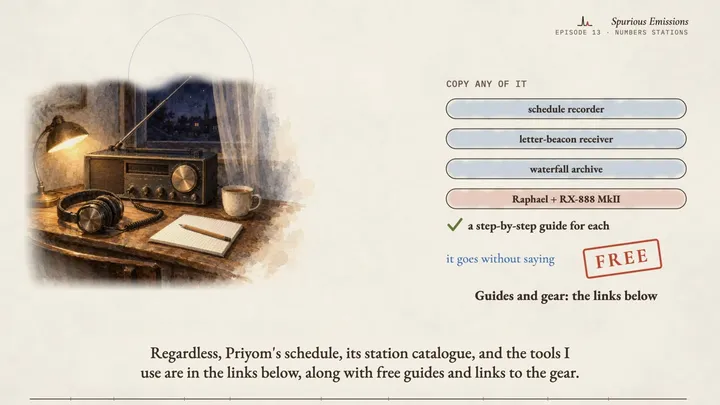
- The recorder, the letter-beacon receiver and the waterfall archive are small programs I wrote for my station. They are not public.
- The opening voice is G06, "German Lady", a Russian station rarely heard now. Recording: Sektor sieben Blau, 5442 kHz, 13 April 2018, CC0 (Wikimedia Commons): https://commons.wikimedia.org/wiki/File:Zahlensendernumber-station-g06-german-lady-long-message-13042018-5442-khz-1930-utc.mp3
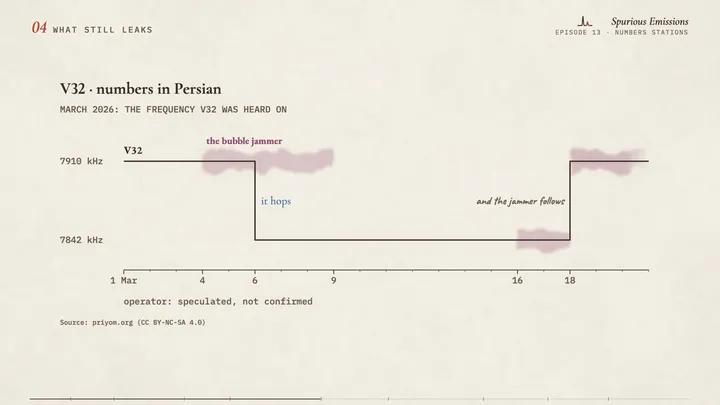
- V32 recording: Wikimedia Commons user آه, 7842 kHz, 11 March 2026, CC BY 4.0 (https://creativecommons.org/licenses/by/4.0/). I used 8 seconds, set its level and faded its ends: https://commons.wikimedia.org/wiki/File:V32_Farsi_numbers_station_recording,_7842_kHz,_March_2026.ogg
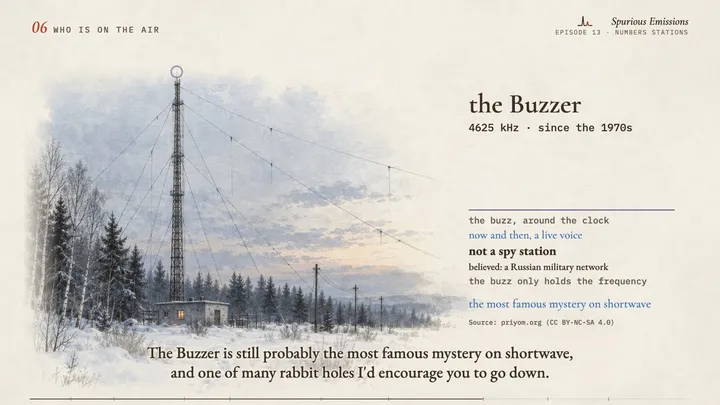
- The Buzzer recording (and its message, MDZhB MDZhB 26 47 GERUNOK): Cqeme, 4625 kHz, 24 January 2013, CC0 (Wikimedia Commons): https://commons.wikimedia.org/wiki/File:Buzzer_2013_01_24.ogg
- XPA2 and the K beacon are real recordings from my own station: XPA2 on 12218 kHz, K on 7039.3 kHz.
- Station facts are from Priyom.org's catalogue (CC BY-NC-SA 4.0). The link between the 2011 arrest and the Tuesday and Thursday schedule is Priyom's hypothesis.
- V32 today: 7910 kHz, upper sideband, every day at 02:00 and 18:00 UTC (on the US West Coast in winter: 6 PM the day before, and 10 AM). Source: Priyom's schedule.
- The pictures of the 2011 raid and arrest are illustrations: the people in them are invented, not the real couple. The kid with the radio, the man in the square and the oak are a sketch of an idea, too.
- All counts are from my own station's first nights, rounded where noted. My antenna is still a small loop.